

















Presents:
Saab 95 Review
| Saab
93 Review |
Saab
95 Review |
Saab
97 Review |
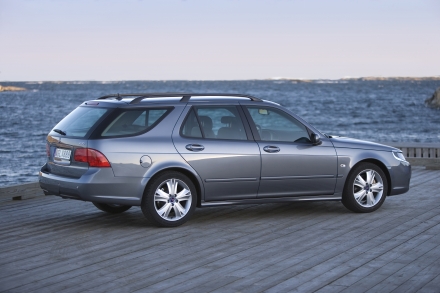
2008 SAAB 9-5: INSPIRING MIDSIZE LUXURY AND PERFORMANCE
The 2008 Saab 9-5 portfolio brings stylish European performance, luxury and value to the midsize sport sedan category. Both the 9-5 Sedan and SportCombi models feature sophisticated, aircraft-inspired design inside and out, befitting Saab’s storied aviation heritage.
For the 2008 model year, the OnStar safety and security system; tire pressure monitoring system and rain-sensing windshield wipers are standard on all 9-5 models, bringing even greater levels of safety and security to the 9-5 series. Leather-appointed sport seats in Black or Parchment also are standard on all models. Also new for 2008, five-spoke high-split alloy wheels are included on the Aero, and power-folding mirrors are included in the Visibility Package.
The Visibility package complements a long list of standard features on the Sedan and SportCombi. The Aero model includes a lowered, sport-tuned chassis; 17-inch, 5-spoke high-split alloy wheels; leather-appointed sport seats with contrasting accents; metallic-finish interior trim, and special Aero badging.
The Visibility Package offers aerodynamic headlamps with xenon projector beams; power-folding and auto-dimming outside mirrors; and the Saab rear-park assist system.
Available stand-alone features include front-ventilated and perforated leather-appointed sport seats and a DVD-based navigation system with trunk-mounted six-disc CD changer, which replaces XM Satellite Radio if ordered.
All 9-5 models are powered by a single 2.3L I-4 Turbo with 260 horsepower (194 kW), and 258 lb.-ft. of torque (350 Nm), mated to a five-speed automatic Sentronic transmission or available five-speed manual transmission.
The Aero sport chassis features a suspension that benefits from increased spring and damping rates, and a larger anti-roll bar than the standard chassis.
The 9-5 Sedan and SportCombi ride on P235/45 R17 all-season tires and standard 17 x 7.5-inch alloy wheels. All Saab 9-5 models are designed for sure-footed driving, thanks to standard electronic stability program, traction control and anti-lock brakes.
Sedan and SportCombi standard equipment
Although the Sedan and SportCombi come with unique equipment and appointments, both versions have the following standard features:
- Leather-appointed sport seating
- Leather-trimmed sport steering wheel
- Cooled, illuminated and lockable glove compartment
- Power moonroof
- Dual-zone automatic climate control with cabin filter
- Eight-way power-adjustable front seats with driver’s side three-position memory
- Power windows with express-down in front
- Power operated and heated exterior mirrors
- 200-Watt Harman-Kardon tuned audio with eight (or nine) speakers
- Six-disc in-dash CD changer (not available with optional DVD navigation system)
- XM Satellite Radio (not available with optional DVD navigation system)
- Saab Information Display with trip computer
- Rear-seat center armrest with pass-through ( Sedan )
- Central locking with remote
- Anti-theft alarm with immobilizer
- Five-year / 100,000-mile powertrain warranty
- Four-year / 50,000-mile bumper-to-bumper warranty
- No-charge scheduled maintenance for three years or 36,000 miles.
And, in keeping with Saab’s safety heritage, all 9-5 models are equipped with the following standard safety-enhancing features:
- Standard OnStar safety and security system
- Electronic stability program
- Tire-pressure monitoring system
- Anti-lock brakes
- Traction-control system
- Dual adaptive frontal air bags
- Head/torso side air bags (front seats)
- Three-point safety belts with front-seat pretensioners
- Pendulum B-pillar side-impact protection structure
- “Triple Load Path” safety cage construction, front and rear
- Saab Active Head Restraints (SAHR) for front seats
- LATCH (Lower Anchorages and Top tethers for CHildren)
- Headlamp delay function (“follow-me-home”)
- Daytime running lamps
- Theft-deterrent system with engine immobilizer
- Passenger Sensing System
Newly standard for 2008, OnStar provides post-crash safety and security services, including notifying emergency services personnel in the event of an air bag deployment. OnStar also provides enhanced, hands-free voice recognition capabilities, including more intuitive continuous digit dialing and improved voice recognition accuracy. OnStar is the leading provider of in-vehicle safety, security and information services in the United States and Canada. Using the GPS satellite network and wireless technology, OnStar features core safety services and OnStar Hands-Free Calling that allows drivers to make and receive voice-activated phone calls using an externally mounted antenna for greater reception.
Saab history
Following the end of WWII, Svenska Aeroplan Aktiebolaget (SAAB) faced an economic shift from the military-industrial complex to the consumer-based market. Looking to diversify, the primarily military aircraft manufacturer gave 16 aircraft engineers license to create the company’s first automobile.
On June 10, 1947 , the automotive division of Saab was officially born, with the unveiling of the original Saab 92 production prototype to Swedish media. More than 4 million cars later, the spirit of Saab’s pioneering engineers lives on in an extensive product lineup that is marketed in more than 50 countries around the globe.
Today, Saab is a division of General Motors Corp. Saab Automobile USA is the importer and/or distributor of the Saab 9-3, 9-5 and the 9-7X SUV for Saab Automobile AB, Sweden.
SPECIFICATIONS
Overview
|
Models: |
Saab 9-5 Sedan and SportCombi |
|
Body style / driveline: |
5-passenger sedan and wagon, front-wheel drive |
|
EPA vehicle class: |
midsize sedan and wagon |
|
Manufacturing location: |
Trollhättan , Sweden |
|
Key competitors: |
BMW 5 Series, Audi A6, Volvo S60/S80 |
Engine
|
Type: |
2.3L inline 4-cylinder |
|
Displacement (cu in / cc): |
140 / 2290 |
|
Bore & stroke (in / mm): |
3.54 x 3.54 / 90 x 90 |
|
Block material: |
cast iron |
|
Cylinder head material: |
light alloy, cross flow type |
|
Valvetrain: |
DOHC, 4 valves per cylinder |
|
Ignition system: |
Saab Trionic-7 with direct ignition |
|
Fuel delivery: |
multi-port injection |
|
Compression ratio: |
9.3:1 |
|
Aspiration: |
water-cooled turbocharger with APC charge pressure control, intercooler |
|
Horsepower (hp / kW @ rpm): |
260 / 194 @ 5300 |
|
Torque (lb-ft / Nm @ rpm): |
258 / 350 @ 1900-4000 |
|
Recommended fuel: |
regular unleaded |
|
Maximum engine speed (rpm): |
6100 |
|
Estimated fuel economy: |
Sedan, SportCombi, man: 18 / 28 |
Transmissions
|
Type: |
5-speed manual, front-wheel drive, fully synchronized with hydraulically actuated clutch |
5-speed automatic, front-wheel drive, electronically controlled with three shift programs: normal; manual and sport; and direct mechanical lock-up in third, fourth and fifth gears |
|
Gear ratios (:1): |
5-speed manual |
5-speed automatic |
|
First: |
3.38 |
4.68 |
|
Second: |
1.76 |
2.94 |
|
Third: |
1.18 |
1.92 |
|
Fourth: |
0.89 |
1.30 |
|
Fifth: |
0.66 |
1.00 |
|
Reverse: |
3.17 |
3.18 |
|
Final drive ratio: |
4.05 |
2.44 |
Chassis/Suspension
|
Front: |
MacPherson struts, lower wishbone, coil springs with twin-pipe gas shock absorbers, stabilizer bars, integrated wheel bearings |
|
Rear: |
independent, multilink with inner and outer stabilizer bars, coil springs, gas shock absorbers |
|
Traction control: |
electronic stability program with electronic traction control |
|
Steering type: |
power-assisted rack and pinion, impact-collapsible steering column |
|
Steering ratio: |
15.9:1 |
|
Steering wheel turns, lock-to-lock: |
2.9 |
|
Turning circle, curb-to-curb (ft / m): |
37.1 / 11.3 |
Brakes
|
Type: |
4-wheel disc with power assist and ABS, dual diagonal with 4 electronic channels, electronic brake force distribution (EBD), self-adjusting, asbestos-free pads, ventilated front discs, solid rear discs |
|
Disc diameter (in / mm): |
front: 12.05 / 306 |
Wheels/Tires
|
Wheel size and type: |
17 x 7.5-in. twin 5-spoke alloy wheels (std.); 17-In. 5-spoke high-split alloy wheels (std. on Aero) |
|
Tires: |
235/45 R17 94V all-season radial tires |
Dimensions
Exterior
|
Wheelbase (in / mm): |
106.4 / 2703 |
|
Overall length (in / mm): |
190.4 / 4836 ( Sedan ) |
|
Overall width (in / mm): |
70.5 / 1792 |
|
Overall height (in / mm): |
57.2 / 1454 ( Sedan ) |
|
Track (in / mm): |
front: 59.9 / 1522; rear: 60.2 / 1529 |
|
Base curb weight w./ standard equipment (lb / kg): |
3470 / 1295 (manual Sedan ) |
|
Weight distribution (% front / rear): |
60 / 40 |
|
Drag coefficient (cd): |
0.29 ( Sedan ) |
Interior
|
Seating capacity (front / rear): |
2 / 3 |
|
Headroom (in / mm): |
front: 37.1 / 956 ( Sedan ) |
|
Legroom (in / mm): |
front: 42.4 / 1077 |
|
Shoulder room (in / mm): |
front: 56.9 / 1445 ( Sedan ) |
Capacities
|
EPA passenger volume |
96.2 / 2724 ( Sedan ) |
|
EPA interior volume |
112.1 / 3255 ( Sedan ) |
|
Cargo volume (cu ft / L): |
15.9 / 450 ( Sedan ) |
|
Fuel tank (gal / L): |
18.5 / 70 |
|
Engine oil (qt / L): |
4.1 / 4 |
|
Cooling system (qt / L): |
7.8 / 7.4 |
Note: Information shown is current at time of publication.